

Nature's Pharmacy
Orangutan medicine, a secret military project, a backyard breakthrough, and algae robots


Orangutan medicine man
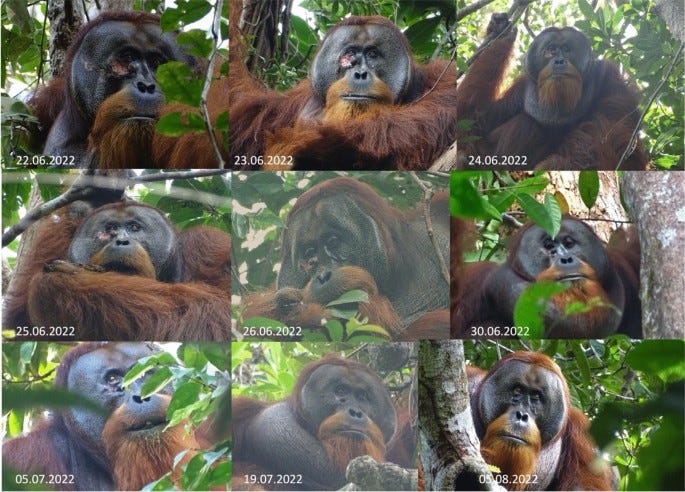
Here is a story: It’s June 22nd, 2022. On a grainy screen, we see a solitary male, late thirties perhaps, stumble into view with a gruesome wound on his face. We don’t know what happened, but he lives in an unforgiving neighborhood. Did he get into a fight?
Fortunately, this brawler (his name is Rakus) knows a thing or two about medicinal plants. He goes looking for a local plant called Fibraurea tinctoria, known in traditional medicine for its pain-killing and fever-suppressing effects. Rakus chews the leaves methodically and applies the pulp to his wound. Again and again. In a matter of weeks, his face knits itself back together, the skin sealing with only a whisper of a scar.
There is a plot twist.
Rakus is an orangutan and this story is the second-ever observation of active wound treatment in non-human animals. Rakus’s actions aren’t just remarkable for their specificity; they fit into a growing body of evidence showing that orangutans and other animals actively use the pharmacy of the forest.
Orangutans, to stay with the russet apes for a moment longer, are no strangers to medicinal plants. The great apes chew the lancet-shaped leaves of the shrub Dracaena cantleyi to apply the resulting anti-inflammatory masticated moist mass to their arms and legs. It’s not the same as treating an open wound, but it’s a form of self-medication nonetheless.
Preceding the story of Rakus, the first observation of active wound treatment was the use of insects by chimpanzees between 2019 and 2021. Chimps in the Rekambo community of Loango National Park, Gabon, were observed applying insects - yes, insects - to fresh wounds.
When nature bares its red teeth and claws and one of the Rekambo chimps suffers a wound, the animal goes looking for an (as-yet-unidentified) insect, pinches part of the insect’s body between its teeth or fingers, and rubs the rest over the open wound. What’s more, the chimps didn’t only treat their own wounds with a mystery bug, but, in some cases, they treated their wounded fellows (and not always relatives either), making it not only the first observation of non-human active wound treatment, but also the first recorded case of non-human ‘allomedication’ — medicating someone who is not you(r relative).
Treating an open wound, whether with chewed leaves or a co-opted insect, is a complex task. But it’s just one branch of a much larger behavioral tree. Even if we look only at primates, we’d find dozens of species using hundreds of plants to medicate themselves. Some swallow bitter herbs to fight intestinal parasites, others rub pungent leaves into their fur to calm skin irritation, and still others weave insect-repelling plants into their nests to keep disease at bay. These aren’t random acts; they’re targeted, often repeated, and seemingly effective.
It would be a mistake, however, to think that the only animals that self-medicate are our cognitively advanced evolutionary cousins. The list of animal pharmacists is surprisingly large and growing, including insects.
The woolly bear caterpillar, for example, eats plant toxins when it’s suffering from a parasite infection, boosting its survival. Monarch butterflies ‘medicate’ their offspring by choosing to lay their eggs on toxic milkweed when they are dealing with parasites. Their caterpillar babies will then eat the milkweed, including its cardenolides (a toxic steroid), and be protected against the parasite that infected their mother.
Some researchers question whether these instinctive insect behaviors qualify as true self-medication. After all, what separates a medicine from a meal when food can be ‘thy medicine’? Which behaviors ‘count’ as treatment and does this have to involve a conscious decision? Whether or not we agree to (not) call it medicine, the beneficial health and survival effects of these behaviors are apparent.
In Lord Alfred Tennyson’s overly bleak view, Nature may be red in tooth and claw, but she is also green in medicine and cure. Long before humans learned to pound bark into poultices or distill medicine from flowers, animals were running experiments in the forest.
Project 523
Let’s leave the Sumatran and Gabonese rainforests behind and explore a secret military project.
Here is the second story: In 1967, as the Vietnam War continued unabated, President Ho Chi Minh sent a request to Chinese Premier Zhou Enlai: help us find a cure for the malaria that is disabling up to 90%(!) of our troops. Zhou relayed the request to Mao Zedong, and what followed was one of the most extraordinary (and, for a while, most secretive) drug discovery programs in history.
Named after its founding date of May 23rd, 1967, Project 523 mobilized scientists across China’s research institutions during the chaos of the Cultural Revolution, at a moment when much of China’s scientific establishment had been dismantled. Against that backdrop, the project assigned one of its most critical branches to a pharmacologist named Tu Youyou, a woman who held no doctorate, no medical degree, and had never studied abroad1.
Tu’s initial breakthrough arrived not in a lab, but in a library. She consulted classical Chinese medical texts and compiled a report of more than 2,000 possible treatments. Among the candidates was a plant called qinghao (sweet wormwood or Artemisia annua), which appeared in a 1,600-year-old emergency medicine handbook written by a Jin Dynasty physician named Ge Hong.
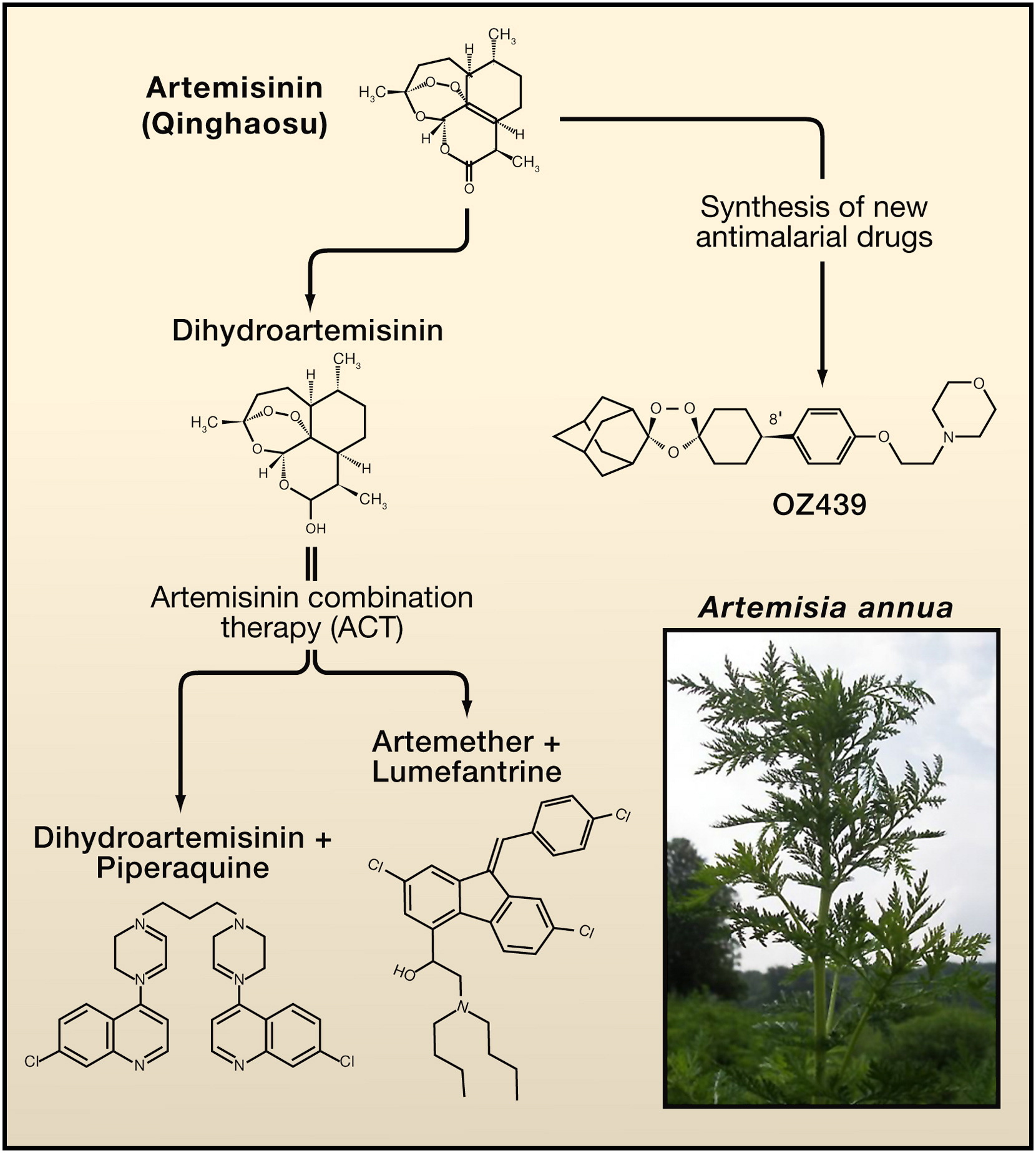
Sadly, extracts of the plant failed to show anti-malarial activity. Tu, however, returned to Ge Hong’s text and noticed something she had overlooked: the instruction was not to boil the herb, but to steep a handful in cold water, wring out the juice, and drink it. The standard high-temperature extraction process destroyed the very compound they were trying to isolate.
After trying again without heat, encouraging results in mouse trials paved the way forward. Tu volunteered to test the first doses on herself. When that went well, clinical trials followed in 1972. All patients recovered.
The Lasker Foundation, awarding Tu its Clinical Medical Research Award in 2011, called the discovery of artemisinin arguably the most important pharmaceutical intervention of the last half-century. The Nobel Prize in Physiology or Medicine followed in 2015. In her acceptance lecture, Tu called artemisinin a gift from traditional Chinese medicine to the world.
Estimates vary widely, but roughly 50% of FDA-approved medications are derived from natural products2. The gift is not traditional Chinese medicine, it’s nature. Interestingly, new screening technologies might even revitalize the interest in nature’s pharmacy.
And we don’t even need a secret military project to find cures.
Our backyard might do.
Backyard breakthroughs
The WHO lists antimicrobial resistance as one of “the top global public health and development threats”, responsible for millions of deaths. The same marvelous process of evolution that makes bacteria, viruses, and fungi such biological magicians also gives them the tools to escape our medications.
Here is our third story: It is 2024, and we are in a garden somewhere in Hamilton, Canada. We take a sample of soil. Nothing extravagant. A teaspoon, tipped into a test tube.
More and more pathogens have developed resistance against every antibiotic we can throw at them. Driven mostly by mis- and overuse, antimicrobial resistance is estimated to become a trillions-of-dollars healthcare burden by 2030, on top of causing many millions of deaths and making routine surgeries and procedures much riskier.
Fortunately, we know an important fact: microbes are really good at killing each other.
So, in pursuit of new antibiotics, researchers scooped some backyard soil3. After letting the samples stew for a while, they tested the potential antibiotic activity of the microbes in the soil samples by exposing them to Escherichia coli, a common inhabitant of our guts that can also cause serious disease.
One of the soil bacteria showed a powerful antibiotic punch.
A species belonging to the genus Paenibacillus used a neat molecule called a lasso peptide to do something no other antibiotic does. The lasso binds to the bacteria’s RNA, which ultimately means that it scrambles the bacteria’s protein-building capacity. In other words, the bacteria’s protein misfold and so, it builds its own weapons of destruction.
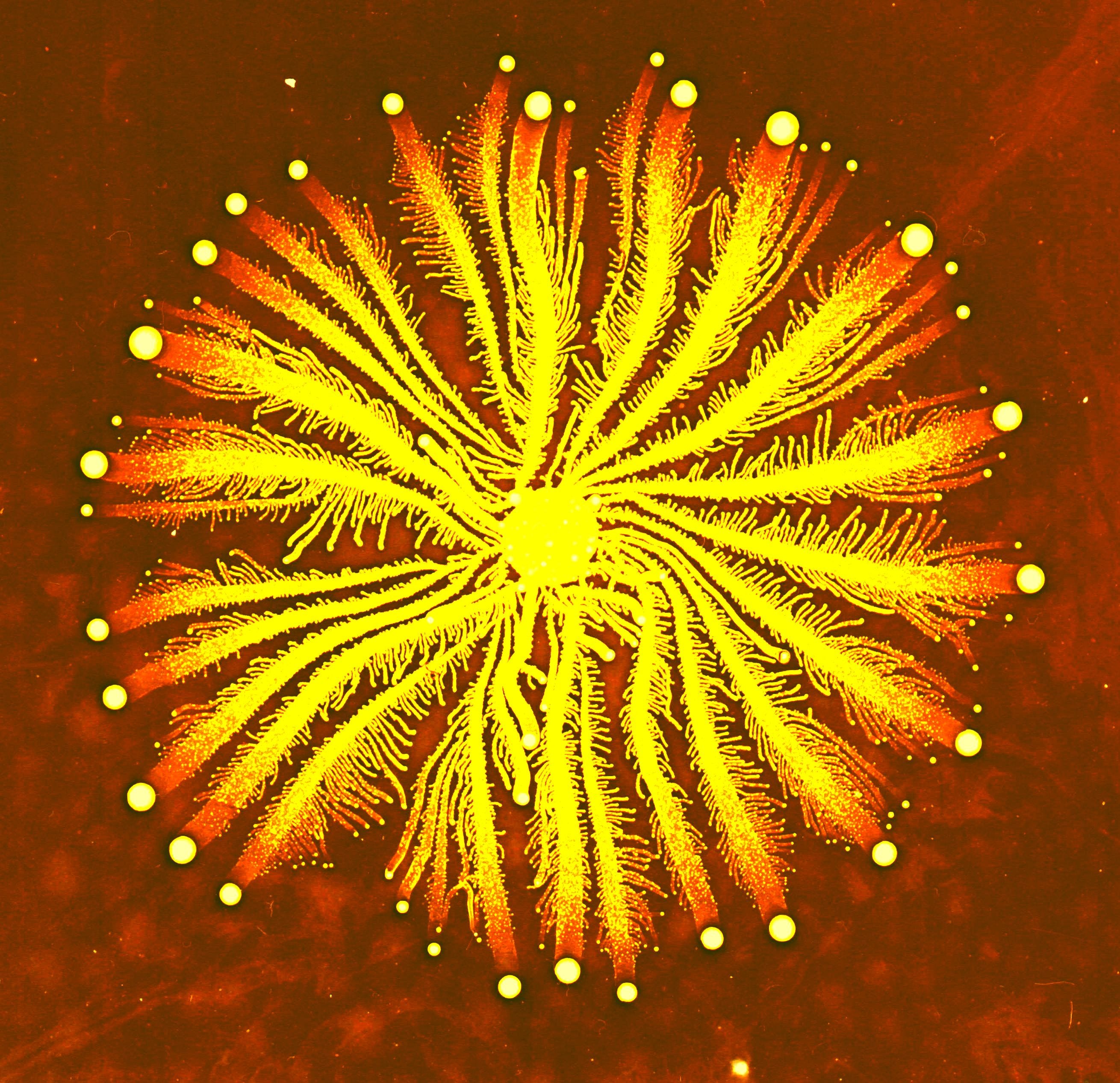
More tests revealed that this lasso - lariocidin - is effective against numerous multidrug-resistant bacteria without harming human cells. Tests on mice bolster its potential as a life-saving treatment. Scientists are now working on improving the molecule’s effectiveness.
All of that from a scoop of soil. Nature’s pharmacy sometimes hides in unlikely places.
Time for ingenious biohybrid robots.
Algae robots (Algabots?)
As the need for refinement of lariocidin in the previous story illustrates, nature provides and we, the ape with delusions of grandeur, can improve on what we discover (if we retain some much-needed humility).
Here is our final story: conventional chemotherapy struggles to deal with lung cancer4. Chemotherapy, delivered through the bloodstream, simply cannot accumulate in the lungs at concentrations high enough to kill tumors there without poisoning the rest of the body in the attempt. For decades, the problem has resisted elegant solutions.
Nature, however, exudes elegance. Often in small packages.
In 2024, researchers enlisted the help of a single-celled alga called Chlamydomonas reinhardtii. A tiny blob no wider than a human hair, C. reinhardtii is equipped with two whip-like flagella that propel it through liquid at roughly twelve body lengths per second5.
Add drug-loaded nanoparticles to the algae’s outer surface, coat them in red blood cell membranes as camouflage for the immune system, and let the tiny swimmers swim. Delivered through a thin tube into the windpipe, the algae distributed the drug deep into the lung tissue of mice in ways that passive nanoparticles or chemotherapy can’t. Treated mice lived 40% longer and when the algabots had done their work, the immune system broke them down into nontoxic components and cleared them from the body entirely.
Let’s up the ante and scale down. For that, consider the kidney. The glomerulus, where the filtration of our blood happens, is an incredibly fine and intricate structure, even more so than the lung’s fine branches. Too fine, in fact, for C. reinhardtii.
Meet Micromonas pusilla, also an alga, but even smaller (1 μm vs Chlamydomonas’s 10).
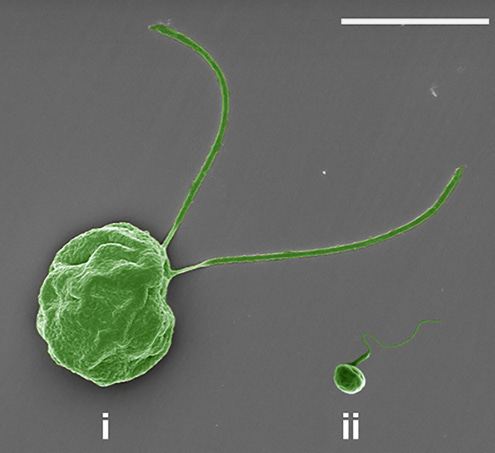
Same story. Load the algae with drug-carrying nanoparticles, inject them into the kidney or the intrarenal artery, and let them do their transport work.
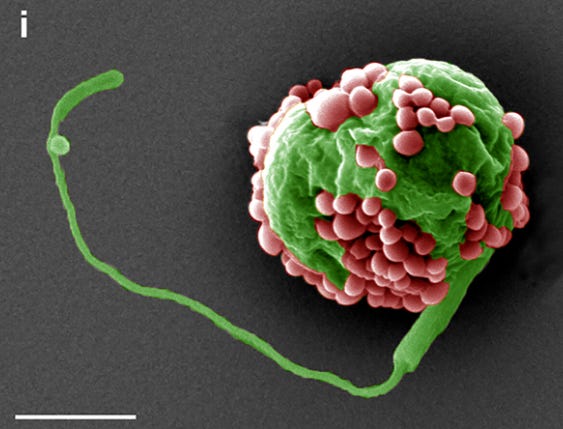
What makes the algabots even more interesting is what they reveal about the relationship between nature and technology. The researchers didn’t build a machine that mimics a living organism. Instead, they borrowed from nature herself, in the form of a little alga that has been swimming through the world’s oceans for hundreds of millions of years.
Evolution is cleverer than we are.
Thanks for joining the trip from the rainforest to algae robots. If you enjoyed it, tip your guide, which can be as simple as clicking a button.
This doesn’t mean all ‘herbal medicine’ is legit. Far from it; it can be the realm of grifters and many, many claims are overhyped. Also, warning: don’t get me started on the grand scam of homeopathy.
A teaspoon of soil can contain a billion bacterial cells and several miles of fungal filaments, most of which are unknown species.
Including metastases from other cancers. The lung is one of cancer’s preferred relocations spots.
By comparison, an Olympic swimmer needs to push hard to get over one body length per second.
The interesting question is how they know: is the knowledge genetic, learnt or shared?
I once met somebody who believed that her horses could be trusted to self-medicate. But that couldn't have been shared cos they left the herd generations ago, how could they learn something they were only going to encounter once in their lives, and genetic assumes they were in the same ecosystem back then.
When you're ill food often tastes different.
Is this why pregnant women get strange cravings?
And, of course, you can always trust your kids to self-medicate in the sweet shop!
Insect Biohacking seems like the ostensibly modern term. Although, I suspect there's much more to it.
The orangutan story was so intriguing to read about. And if not for you, dear Subtle Sparks, I would not have known of such a stellar example of this equally intriguing topic.