

Container Technology
Carrier bags, contain/expand, and SpudCells.


Before we get into it, a double publication alert:
My octopus essay is up at Clarkesworld Magazine. Of course, days after it was published, octopuses had to go be all awesome, and new research came out showing how they’re just better at building proteins than anyone else.
My dragon story appeared in the summer issue of Kaleidotrope.
Carrier bags
In 1979, the book Woman’s Creation: Sexual Evolution and the Shaping of Society by American author Elizabeth Fisher was published. It’s an ambitious work in which she reimagines the common story of humanity’s evolution from a female perspective.
The often hidden work and inventiveness of women, Fisher suggests, have been crucial in shaping human civilizations. The pivotal point in early human technological development was less about ‘hunt fight kill’, and more about ‘gather store distribute’.
In the book’s most influential chapter (seven), Fisher develops the carrier bag theory of evolution. One of the first human inventions, the theory goes, was the infant sling. When new moms (and likely other female relatives) realized, “Hey, this is convenient, my hands are free now,” carrier bags became a staple technology of our nomadic hunter-gatherer ancestors. Now they could carry some food with them, and it became worthwhile to learn to make (better) stone tools because, again, they could take ‘em along on their journeys.
We don’t know (and possibly can’t know) how accurate this view is. The earliest bags were probably made of materials that degrade quickly — plant fibers, furs, and so on. A recent study that looks at mobile containers from the Pleistocene suggests that ‘sturdy things to carry stuff with’ may have appeared as early as 500,000 years ago. The earliest bags likely appeared before that. For reference, early stone tools predate the genus Homo. The so-called Lomekwian stone tools date back 3.3 million years. More recognizable stone tools, such as Acheulean hand axes, may have been in use as early as 1.76 million years ago.
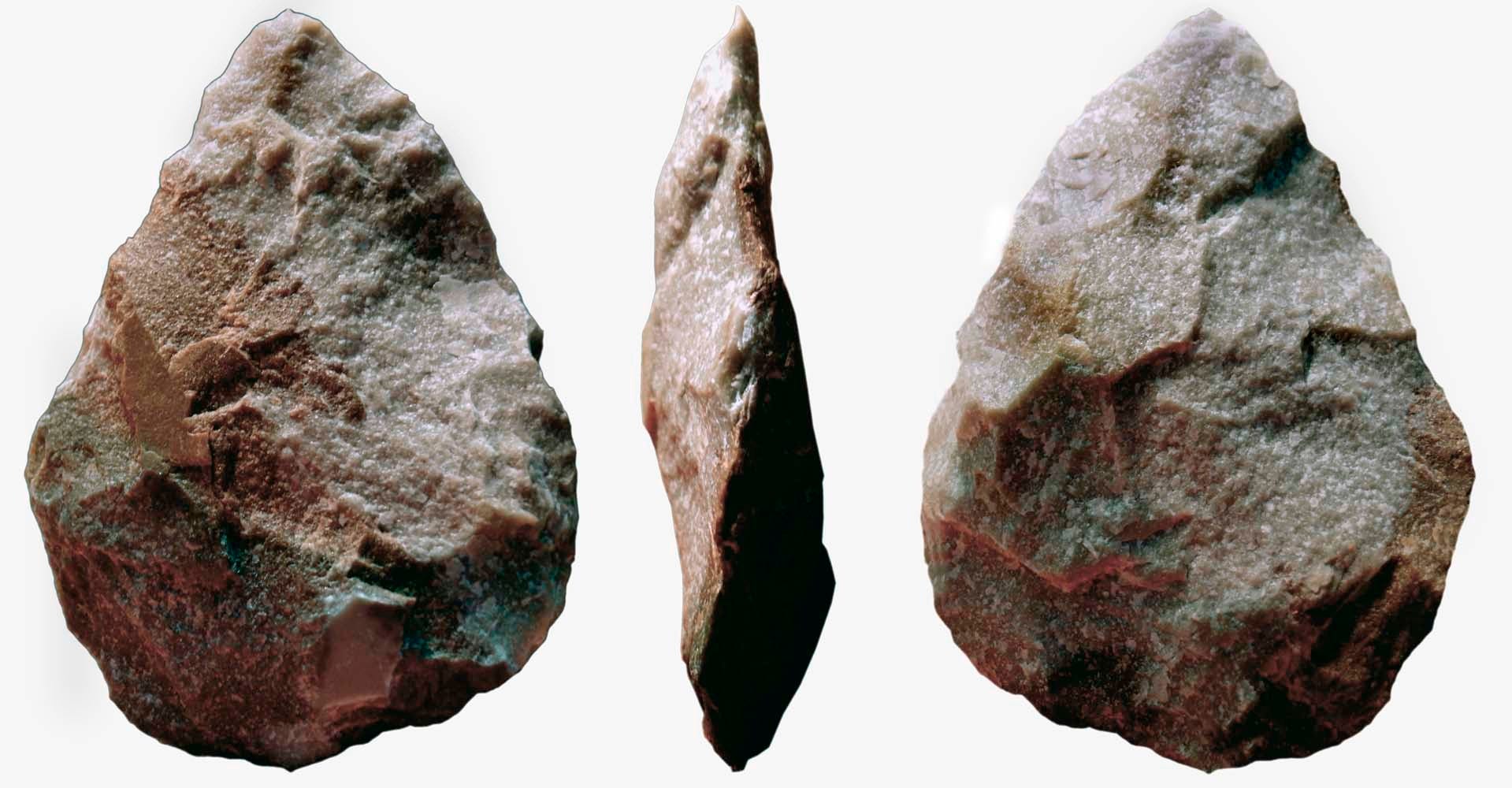
This murky timeline can get updated any moment a new archaeological find is made, but it seems reasonable to classify bags and containers as early and important technologies.
Even if Fisher’s book and theory make a few (overly?) bold claims, they provided a welcome and necessary counterweight against the ‘Man the Hunter’1 narrative of human evolution.
The carrier bag theory of evolution made such an impression on (science) fiction titan Ursula K. Le Guin that she used it to develop her own carrier bag theory of fiction. Growing up during the Golden Age of science fiction, Le Guin encountered many Man the Hunter stories. Our (often white, even more often male) Hero fights and kills and imperiously stomps his way from beginning to end, straight as an arrow. Per Le Guin,
So the Hero has decreed through his mouthpieces the Lawgivers, first, that the proper shape of the narrative is that of the arrow or spear, starting here and going straight there and THOK! hitting its mark (which drops dead); second, that the central concern of narrative, including the novel, is conflict; and third, that the story isn’t any good if he isn’t in it.
Instead, Le Guin argues, a novel, a narrative, is more like a bag2. A medicine bundle.
When I came to write science-fiction novels, I came lugging this great heavy sack of stuff, my carrier bag full of wimps and klutzes, and tiny grains of things smaller than a mustard seed, and intricately woven nets which when laboriously unknotted are seen to contain one blue pebble, an imperturbably functioning chronometer telling the time on another world, and a mouse’s skull; full of beginnings without ends, of initiations, of losses, of transformations and translations, and far more tricks than conflicts, far fewer triumphs than snares and delusions; full of space ships that get stuck, missions that fail, and people who don’t understand.
Sometimes, we all need a hero. And a spear has its uses. Few things fly as smoothly as a finely crafted arrowpoint.
But container technology is important, too. Even today.
Contain/expand
(Warning: metaphors are about to be stretched.)
Take the infant sling and make it larger. Larger still. And we want it sturdy, for safety. Now it’s too heavy, so add wheels and an engine because no one’s going to carry that.
Hey, we have a car.
A car is a bag. A rigid one, admittedly, but a bag nonetheless, a container built to hold a body (or several) and move it somewhere the body couldn’t easily (or rapidly) go on its own. A plane is the same thing, just scaled up until ‘somewhere’ means another continent. Sling, basket, wagon, car, plane… they’re all part of an evolutionary lineage, cranking up volume and range generation after generation.
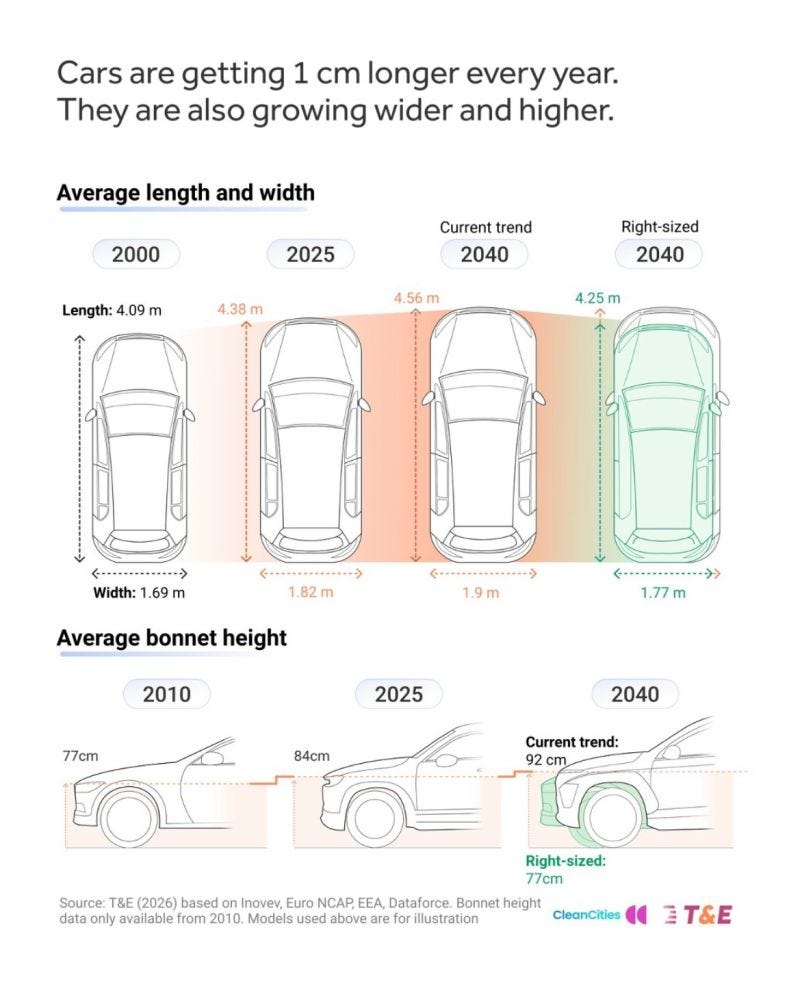
Cars and planes are containers for people3.
They are also reminders that a good container doesn’t just ‘contain’. It enables and expands. Yes, cars and planes contain us. We are strapped in seats, are subjected to speed limits and specific roads or flight routes, and we have to follow a set of rules to prevent container collisions. At the same time, they enable us to travel faster and farther, expanding the distance we can cover in any given time.
Time to stretch the container analogy a little more.
Close to me lies another high-tech container that holds so much it makes me squirm with a vague discomfort.
My phone.
It contains years of memories, contact details for the people in my life, and access to admin stuff that is the bane of adulting. It enables me to dive into all that the internet contains4 (and data servers across the globe contain the internet itself). My phone, light and easy to carry, expands the memory, computing power, and navigational abilities available to me5.
What a phone contains, though, feels blurrier than what a car holds. Less circumscribed, perhaps. Multiplicitous, to slap syllables together in a way that strangely upsets my spell-check. A phone is a pluralistic container that also contains hidden arrow points. A social media feed doesn’t hand you the world; it hands you a curated sliver of the world, shaped by opaque algorithms and optimized for outcomes (your attention, your next thirty seconds of scrolling) that rarely overlap with your own. Parts of your phone perform bagginess while quietly functioning like an arrow underneath, aimed at a mark you didn’t choose.
Welcome, this is the part where the dichotomy breaks down. Much like models, all metaphors are wrong. But some are useful. In this case, ‘container technology’ is a nice conceptual reminder that technology need not be (purely) active, probing, and manipulator-like6. Sometimes, profound technological shifts can come through simply holding things. Though it’s rarely as simple as that.
This brings me to the last bag I want to talk about. Life.
SpudCells
Life is not a box of chocolates, but a bag of molecules.
After all, a cell, the basic building block of life (as we know it…) is a bag of molecules.
It’s a fancy bag, though. It selectively lets some things through while keeping other stuff in or out. It cleans itself. It makes more of itself (with help from its contents, of course).
We’re still figuring out where that bag came from7.
And, as the Richard Feynman aphorism states,
What I cannot create, I cannot understand.8
Enter SpudCells. AKA beautiful blobs. AKA the first synthetic cells with a complete cell cycle.
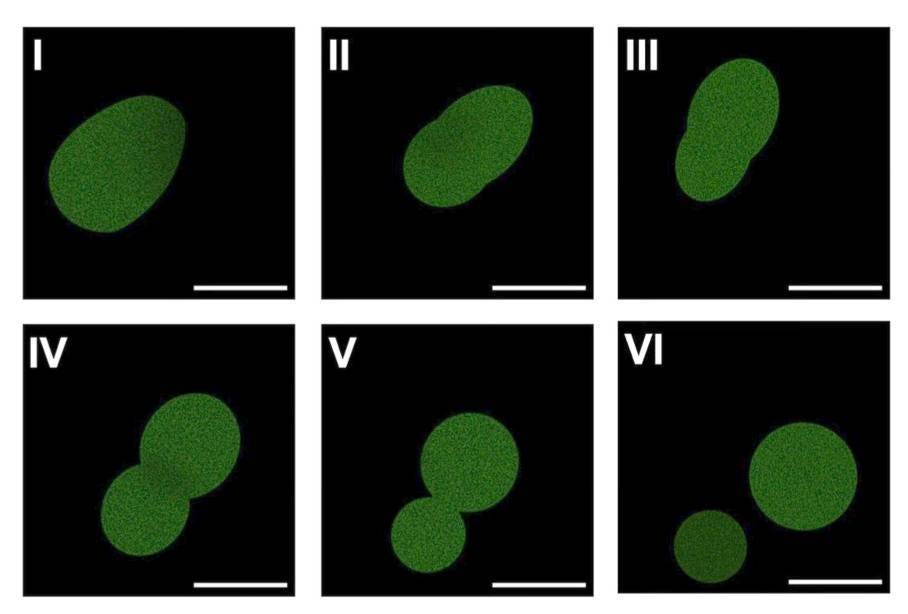
A team at the University of Minnesota, led by Katarzyna (Kate) Adamala9, built these cells from scratch — no borrowed, emptied cell, no minimized bacterium, just a liposome (a little lipid bag) stuffed with a few key ingredients: a 90,000-base-pair genome spread across seven plasmids and a protein-making system called PURE.
These curious liposome bags ‘eat’ by fusing with tiny ‘feeder’ liposomes that provide lipids, enzymes, and small molecules in the synthetic equivalent of a grocery run. The SpudCells copy their own genome and, after some accumulated growth, split into daughter cells, each one inheriting a share of that genome.
Do this five times in a row — feed, copy, divide, feed, copy, divide — and you get five generations of a synthetic lineage. Now add evolution to the mix. When the researchers introduced a mutant gene that allowed the adorable little SpudCells to fuse with more feeder bags, the cells with that mutation grew faster and had more daughter cells.
SpudCells are not alive in the fullest sense. These cells can’t (yet?) make their own ribosomes (protein builders) and they can’t sustain themselves without a human topping up the feeders.
Even if they’re not alive, SpudCells are a marvelous example of a container technology. They also show that bags can be more than they seem.
Carrier bags freed our hands to continue our journey as a tool-making species. Le Guin’s bags hold words that, read just right, can build and break worlds. And the SpudCell is a little bag that might help us answer some of the greatest questions in biology.
Thanks for joining me in exploring this container of ideas. If you enjoyed it, like, share, subscribe, and all that. Also, what’s your favorite container technology?
A few years ago, there was some controversy about a study that pushed back against the entrenched view on division of labor among hunter-gatherers (men hunt, women gather). Women, too, hunt, and more often than we’d think. Other researchers responded. Yes, but we still see gendered divisions of labor.
As someone who did a PhD on the evolution and ecology of behavior (though not specifically human, so I claim no in-depth expertise on this specific matter), the online fallout of these discussions both interests and infuriates me. Say it with me: context, context, context. Whether or not women hunt or men gather depends (in part) on what the environment provides. If it makes sense for women to hunt (for example, there’s a lot of accessible big game), they do, and women can be highly skilled hunters.
Also, research just came out as I’m finishing this post about ancient Egypt’s (potential) warrior princesses. And it keeps coming. Turns out that the 4000-year-old Uptown Lovell Shaman, found near Stonehenge, and famous for elaborate metalworking tools buried alongside him, is… a her.
And she was not the only (female) writer who saw it that way.
A book is simply the container of an idea like a bottle; what is inside the book is what matters.
- Angela Carter
A novel, in the end, is a container, a shape which you are trying to pour your story into.
- Helen Dunmore
We can make a similar argument for houses and other buildings.
Architecture is basically a container of something. I hope they will enjoy not so much the teacup, but the tea.
- Yoshio Taniguchi
The Internet is a container, not a substance.
- Alison Owen
This reminds me of a great essay by Vida Cruz-Borja on active and inactive protagonists in stories, which won the 2022 IGNYTE Award for Best Creative Nonfiction.
I will try to contain myself and not go wild with origin of life hypotheses (another time, perhaps), but one such hypothesis - the lipid world hypothesis - suggests that membranes, more specifically lipid bags, came first, pre-dating genetic material (as in the RNA-world hypothesis) or autocatalytic cycles (as in the metabolism-first hypothesis). In reality, we probably need an integrated view that combines these non-mutually exclusive hypotheses. And my favorite idea here is the hydrothermal vent hypothesis, which suggests that deep-sea vents may have been the perfect place to kickstart the biochemistry we now call life.
a) A quote left on his blackboard at the time of his passing.
b) Often revered, far be it from me to dismiss Feynman’s influence on both physics and science communication. I have to note, however, that his views on women and his sense of entitlement in that context were far from wholesome.
For now, the research is a preprint, but, in a beautiful open-source move, Adamala and colleagues have set up Biotic, a public-benefit nonprofit research organization, through which they will continue to develop and refine the SpudCells in a transparent way that allows other researchers to learn, contribute, and co-develop these synthetic cells. Biotic is on Substack, too, so you can go read their launch post.
"SpudCells are not alive in the fullest sense. These cells ... can’t sustain themselves without a human topping up the feeders."
We can't sustain ourselves without the sun topping up the feeders.
Much like models, all metaphors are wrong - models ARE metaphors, pure and simply.