

To Be Young Forever
Neoteny, Neanderthals, and we, babies


If you’re looking for full-blown biological immortality, check out my latest Clarkesworld Magazine essay.
Neoteny
In the lakes scattered through the Mexican highlands lives a curious creature that has been named after the Aztec god Xolotl, the deity of fire and lightning, the dead and the resurrected, and of grotesque, ugly beings.
The etymology does no justice to the invariably cute axolotl. A large head, a silly grin, and a garland of gills. Almost like an amphibian puppy.
Amphibian puppy is not too far off the mark. Axolotls are neotenic, which means that they do not undergo a metamorphosis to reach their adult form, but retain juvenile characteristics (the gills, the finned tail…) for their whole life.
Due to habitat destruction, most axolotls these days live in captivity. The wild form of the axolotl has dark, olive-tinted skin with spots on the tail. The leucistic form (on the left in the photo above), with its white skin and vibrant gills, is more popular in captivity1. I suspect that the right one in the photo is a dark (or melanoid) color morph.
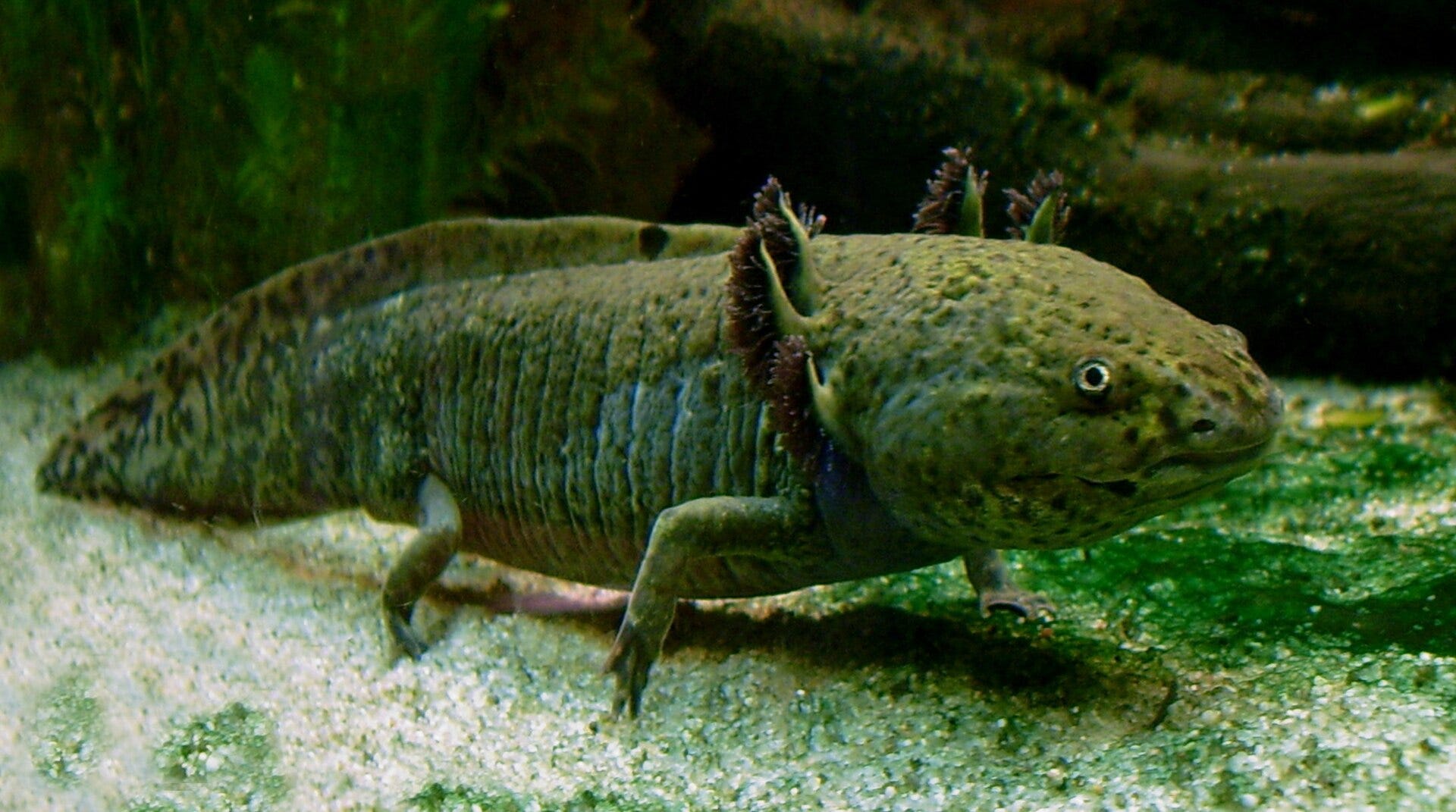
Amphibian metamorphosis is driven by, among others, thyroid hormones. The brain signals the pituitary gland, which releases a hormone that tells the thyroid to produce thyroid hormones, which then instruct the body to transform. In axolotls, the brain’s signal to the pituitary is somehow impaired, so the whole cascade never gets going, and the axolotl remains in its juvenile form for life.
But the hormonal machinery works; it just never gets to do its metamorphosing thing. So… what if we add thyroid hormones? Metamorphosis! It’s been known for over a century that if we give axolotls thyroid hormones, we end up with their final form2.
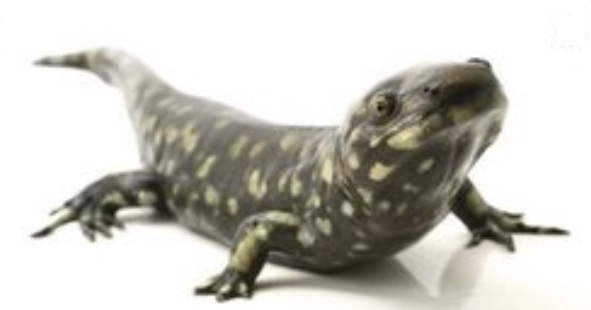
A metamorphosed axolotl undergoes significant changes: External gills are reabsorbed, the skin thickens, the tail fin disappears, and the legs get bulkier.
In the wild, however, our amphibian puppies no longer need metamorphosis because, despite their youthful appearance, they do reach sexual maturity.
Axolotls are big babies.
Like humans. And Neanderthals.
Big Neanderthal babies
On average, Neanderthals had the largest brain size of all hominids — about 1,410 cm³ vs modern humans’ 1,350 cm³. As in Homo sapiens, brain size probably limited baby size in Neanderthals. The birth canal can only get so big without problems.
So Neanderthal newborns were likely similar in size to little sapiens.
After birth, however, things start to diverge.
We have only a few infant Neanderthal skeletons, but the ones we do have suggest that little Neanderthals grew roughly twice as fast as little sapiens. For example, Amud 7, a Neanderthal infant whose skeleton was unearthed in Israel, was around six months old. Yet, its body and brain were equivalent to those of a one-year-old sapiens. By the age of eight, however, modern humans catch up.
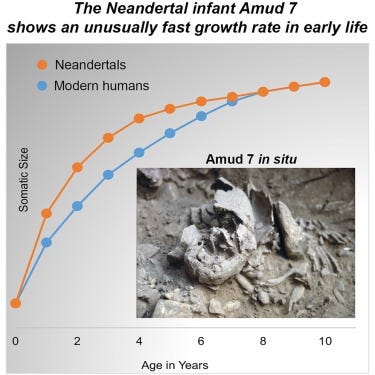
Amud 7 was likely not an exception. Other Neanderthal kid skeletons hint at a similar growth rate.
What’s going on here?
We can’t be sure, but here are a few ideas to explain the faster initial growth rate of Neanderthals:
A need for earlier independence in a harsh, unforgiving climate and environment (though we don’t know if our burly Neanderthal kids actually started walking earlier, for example).
Larger bodies also maintain body heat better in cold environments, which could have been crucial in early development, especially with big, hungry brains.
Neanderthals probably lived in smaller groups. Here, too, early independence might have been useful.
But maybe Neanderthals didn’t grow unusually fast. Maybe modern humans grow unusually slowly.
After all, modern humans are just (partially) neotenic apes.
You, too, are a partial puppy
The idea that humans are neotenous apes was most famously articulated by the (in)famous evolutionary biologist Stephen Jay Gould in Ontogeny and Phylogeny (1977), building on earlier work. Adult humans, he suggested, resemble juvenile great apes more than adult great apes.
For example, we have relatively flat faces and reduced prognathism (our jaws don’t project forward). We also have large, round braincases and relatively large eyes. Add small teeth and (for most of us) sparse body hair. Our brains keep growing for a while and we stay dependent on our parents for longer than chimp toddlers3. Also, unlike mature chimps, adult human males (unfortunately?) lack a penis bone or baculum.
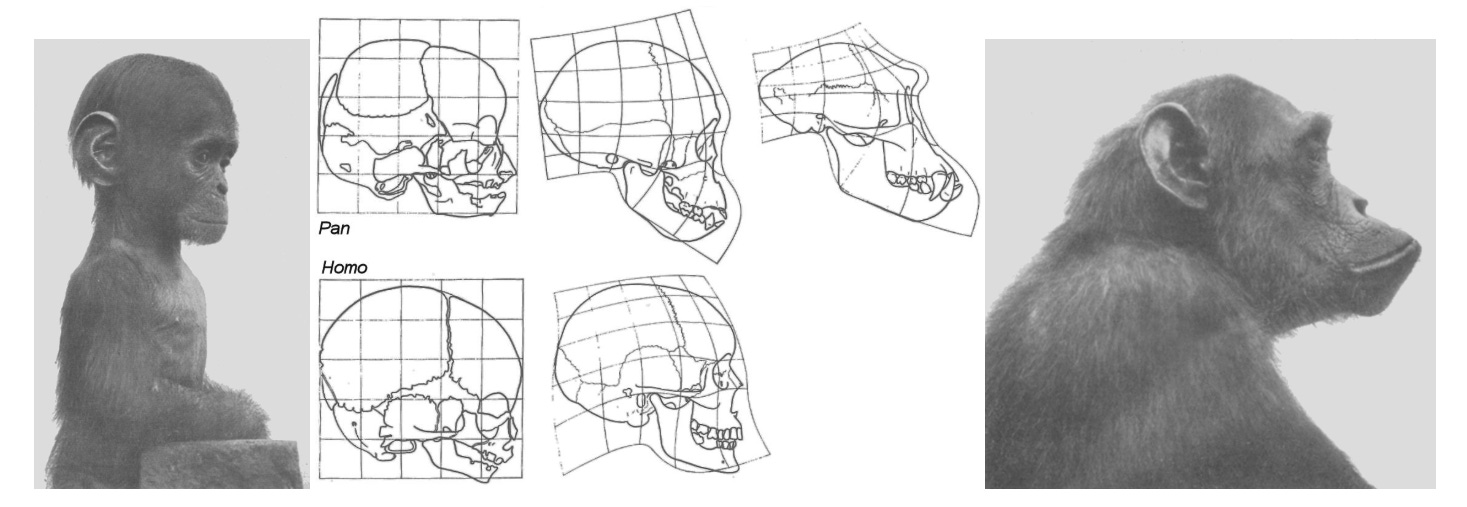
The mechanisms behind our neotenous selves include changes in regulatory genes, hormonal delays, and prolonged neural plasticity. For example, our prefrontal cortex isn’t fully myelinated until our mid-twenties.
Because nothing is ever as easy as it seems, not all apparently ‘juvenile’ human traits have a single developmental explanation. Human brain size is a good example4. It involves both neoteny- retaining the high brain growth rate that chimps lose shortly after birth - and (Scrabble alert) hypermorphosis, or an extension of the total growth period. The rate stays high, and it runs for longer. Together, these produce a brain far larger than a chimp’s. A more accurate framing might be that we are mosaics, not just across traits but sometimes within them. We’re patchwork puppies.
That’s the how. As for the why, we can only rely on hypotheses. There are three main, intermingling ideas here.
First, there could have been selection for plasticity itself. A longer juvenile window means more time to learn from the environment rather than running on instinct, which is a massive advantage when your environment keeps changing. You can, of course, learn as an adult, but a child’s brain is tailored to it.
Second, humans are (or certainly have been) prime cooperative breeders. Once the proverbial village started sharing the childcare load, mothers could afford to produce slow-maturing, big-brained, helpless offspring without it being a reproductive death sentence.
Finally, men appear to prefer neotenous features in women. Sexual selection for neotenous facial features (flatter faces, larger eyes) has been proposed to, in part, drive our morphological neoteny. Male facial neoteny would then be a by-product. This is the most contested of the three. It’s causally iffy and may reflect cultural biases more than actual selection pressures.
I like to think that our neoteny gives us the beautiful ability to keep learning and playing. Perhaps retaining a child’s sense of wonder isn’t just a metaphor for living well. It might be a description of what we are, the ape who wonders.
Like any good brainchild, this post needs attention. Click buttons.
Thirty-three axolotls were imported from Mexico to Europe in 1863 to establish a population at the Jardin des Plantes in Paris. One of these amphibians was leucistic. This is possibly the progenitor of the leucistic form of the popular pet of today.
Hybridization experiments between axolotls and tiger salamanders produce offspring that can metamorphose. Also, this whole process has a distinct Pokémon feel to me.
These features are also relevant for the self-domestication hypothesis about human evolution. Neotenous traits often coincide with domestication. For example, in companion animals, we often breed for cuteness, which usually involves a collection of juvenile traits.
Other features of the brain, like gene activity, are more straightforwardly neotenous.
Have you read the Goodness Paradox? It also talks about the rise of neoteny but in the context of reduced aggression. His theory is a little darker - negative selection pressure on aggression through capital punishment 😬.
Going back to the relatively accelerated development of Neanderthal infants: I read that this would have placed significant energy costs on the mom (more or fattier breast milk production.). Any thoughts on that relative to Sapiens? Would there have been some advantage to us to reducing the burden on the mom? I also wonder if there were any differences in when babies were typically born. If a baby is born during a relatively lean time when mom’s breast milk is less abundant or lower calorie, everyone would benefit from lower calorie needs.